How I Ran My First Marathon in Seville
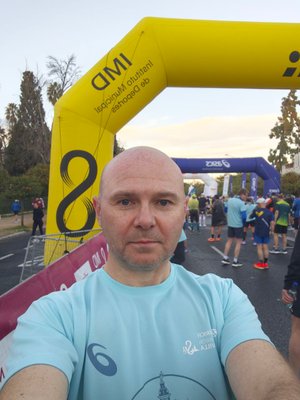
On February 15th, I ran my first marathon — the Zurich Maratón Sevilla. 42 kilometers and 195 meters. I finished in 4:09:18. Didn't break the four-hour mark as I'd planned. That's worse than I wanted, but much better than I feared. My fear was that I wouldn't be able to keep running and would have to walk part of the way. That didn't happen, and I made it!
Why a Marathon and Why Seville
I started running in the summer of 2024. Over a year and a half, I ran two official half marathons. After the first one, I decided that in about a year I should try the full distance, and started looking at what's out there. I chose the Seville Marathon for several reasons: the flattest course in Europe (only 10 meters of elevation gain!), the timing was just right — about a year out, plus a comfortable February season with no heat. On top of that, Seville is relatively close, and the city itself is worth visiting. Slots sold out within 20 minutes of going on sale — good thing I'd subscribed in advance and grabbed one as soon as the notification came in.
Training with Claude
I prepared for the marathon with Claude (and initially with ChatGPT). They put together a training plan for me, gave advice on nutrition and load management. AI as a coach — sounds weird, but it works: the plan was structured, took my level into account, and gradually built up volume. I didn't always follow it strictly, to be fair — life has a way of getting in the way — but I kept the general direction. Turned out to be a perfectly viable approach.
Getting There and the Expo
We took a bus from Portugal two days before the race, since we'd bought the tickets before we got a car. Otherwise we would've driven, of course. On Saturday, we went to pick up the race pack at the marathon expo. The place was packed. A huge venue with sponsor booths and all kinds of sports gear for sale: shoes, apparel, gels, accessories. I bought a new cap because I couldn't find mine when I was packing.
Seville itself was lovely — a beautiful, clean, pleasant city. We walked around, explored. As it turned out the next day, though, a marathon is the best way to see all of Seville in 4 hours. And I mean literally all of it. Including the residential outskirts and industrial zones.
Race Morning
The marathon started at 8:30, but I woke up at 5 for no good reason and couldn't fall back asleep (we're talented like that, yeah). It was 6°C in the morning, and I got properly cold walking to the start. But now I know what experienced marathoners do — they put on anything they don't mind throwing away, from old (or even new) sweaters and hoodies to disposable rain ponchos and just plain garbage bags. Once we started running, though, things heated up — and not just literally.
The First 20 km
The first kilometers are pure joy. Lots of energy after the taper. A huge crowd (around 12,000 runners, though initially 17,000 were announced), spectators lining the entire course, the energy is just incredible. Running felt easy, my legs carried me on their own. Seville's flat course is truly a gift: not a single serious climb, you just run and enjoy the city. Little kids reaching out their hands for high fives. Whistles, noisemakers, drummers, DJs along the route. There was even a live rock band.
I tried to hold a pace of around 5:30–5:50 per kilometer. I ate a gel roughly every 5 kilometers — energy kept coming, legs kept working. I ran the first half of the marathon in 1:59:59 net time — exactly sub-2 for the half! At that point, sub-4 at the finish still felt totally realistic. But...
The Wall at 32–35 km
Everyone says the marathon starts after the 30th kilometer. It's true. Up to 30 km, my pace held steady at around 5:49 per kilometer. And then a completely different marathon began.
At 32–35 kilometers, it hit me. My legs turned heavy, every step took effort. The gels wouldn't go down anymore — I never finished the last one. The only thought in my head: just let this be over. My pace started slipping: 5:52, 5:56, by the finish — 5:58 per kilometer. Seems like a small difference, but when every kilometer is a battle, those seconds feel like minutes. I'm convinced the organizers are frauds: after the 35th kilometer, each one was somehow twice as long as the last (I'm sure everyone makes this joke afterwards, but still).
The Finish
Many people around me had stopped running — they were just walking. But I wouldn't allow myself that. I only slowed down at water stations to avoid spilling water from the cup. And I made it.
I crossed the finish line in 4:09:18 net time. Not the sub-4 I'd dreamed of. But a first marathon is a first marathon. I'm still proud of myself, and I'm happy with it.
After the Finish
The finish area is a sight of its own. Some people stood hunched over by the barriers, quietly throwing up. Others were being wheeled away in wheelchairs because their legs had given out. Some were lying flat on the ground with their legs up in the air. They handed out water, electrolyte drinks, various beverages. I got a wooden medal (do they not give out metal ones at all anymore?).
I spent the rest of the day mostly lying down. My legs hurt so much that walking on flat ground was bearable, but stairs were a disaster. My wife, as luck would have it, had rented an apartment with a magnificent two-flight staircase. Going down it must have looked so comical that it deserved its own video — which she did, in fact, record. My legs were still aching the next day too.
The Numbers
For the stats-minded:
| Split | Net Time | Pace |
|---|---|---|
| 5 km | 0:29:01 | 6:24/km |
| 10 km | 0:57:37 | 6:03/km |
| 15 km | 1:25:43 | 5:54/km |
| 20 km | 1:53:47 | 5:50/km |
| Half | 1:59:59 | 5:49/km |
| 25 km | 2:22:18 | 5:48/km |
| 30 km | 2:51:42 | 5:49/km |
| 35 km | 3:22:39 | 5:52/km |
| 40 km | 3:54:55 | 5:56/km |
| Finish | 4:09:18 | 5:58/km |
Average heart rate — 155. Calories burned — 3,208. Distance per watch — 43.13 km.
Takeaways
I lost most of my time at the start, stuck in a dense crowd. It was very hard to get up to my target pace. Next time I need to push further to the front (yes, I do want to run another one, even though on those last kilometers I was thinking I'd had enough).
I also need to prepare better: gear-wise — the shoes could have been better, for one — and physically, and mentally. If I hadn't woken up at 5 in the morning, maybe I would've made sub-4. We'll keep trying!